
A New Chapter for Denver Real Estate
Momentum in Denver’s housing market continues to point toward long-term stability
The gradual, sustained trends that have emerged throughout 2025 are shaping a more measured landscape—one defined by steadier pricing, balanced inventory, and strategic decision-making on both sides of the table.
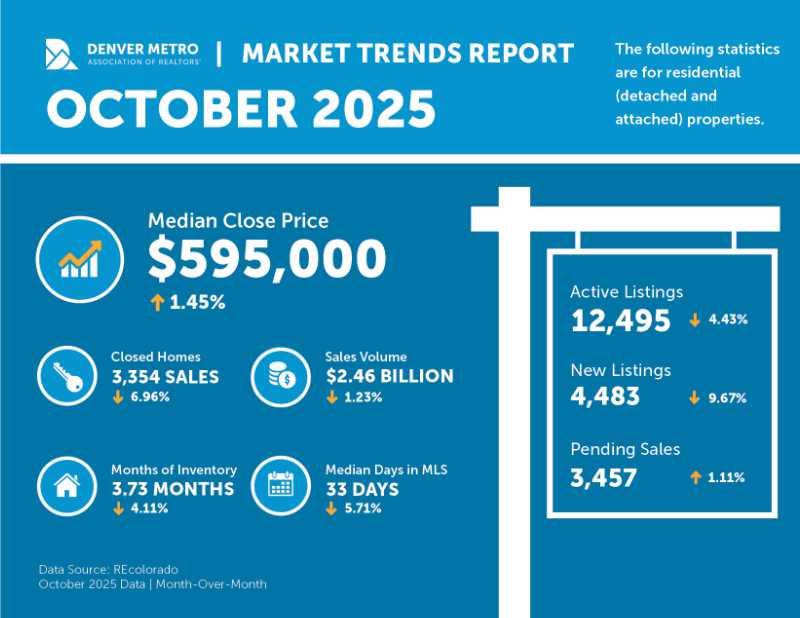
Inventory continues to define the market’s direction. Even with fewer new listings, overall supply grew year-over-year as homes took longer to sell and buyers became more selective. Detached inventory rose 13.4%, and attached inventory climbed 15.8%, reflecting a consistent pattern of increased choice for buyers.
Historically, this kind of equilibrium has indicated a maturing market rather than one in decline. The slight 4.5% month-over-month decline in active listings shows that, as we head into the slower season, the market’s cooling is measured, not abrupt.
Days on market told a similar story. Detached homes spent a median of 31 days in the MLS, while attached properties spent 41—just two days shorter than in September, suggesting mild improvement in absorption. While properties are still taking longer to sell than they did a year ago, the pace is now stabilizing. Buyers know they have more breathing room to make informed decisions, and sellers who prepare, present, and price thoughtfully are still seeing results within a competitive timeframe.
Pending and closed transactions also reflected that balance. Pending contracts rose almost 3.5% compared to last October and just over 1% month-over-month, signaling a slight lift in buyer activity likely helped by the early-October dip in mortgage rates. Detached pending sales rose 6% annually, while attached homes slipped 6%. Closed sales told a different story—down almost 8% year-over-year and almost 7% from September—with detached down 6% and attached down 13%. The contrast between pending and closed transactions suggests that while demand remains present, execution is increasingly deliberate.
Price movement reinforced the same theme. The median detached home price of $650,000 held nearly steady from September, and attached saw only a 0.5% dip. Both segments sold at roughly 98% of list price, underscoring that well-priced homes continue to command strong values. Over the longer term, this represents normalization rather than decline. Between March 2020 and April 2022, Denver’s median home price rose 38.5%—an astounding average annual growth rate of 19.25%. Since then, appreciation has slowed to an annualized 6.7% through October 2025, positioning prices within their historical range and creating a foundation for sustainable, long-term growth.

For Sellers
Sellers today are facing more competition than meets the eye. Beyond neighboring listings, new construction continues to be a powerful player—sales rose 20% as of August, marking a three-year high, and builders are offering the most buyer incentives in five years. Meanwhile, rental communities are drawing attention with promotions like 12 weeks of free rent or even ski passes at signing. Buyer terminations during inspection are also on the rise, often over small issues, revealing a buyer pool that’s increasingly cautious and detail oriented. For sellers, success comes from anticipating these dynamics: addressing repairs upfront, pricing strategically, and staying flexible through negotiations. Realism sells.
For Buyers
For buyers, moderation brings opportunity. Prices continue to grow slowly and steadily, inventory has expanded, and the competitive rush that once defined Denver’s market has eased. This allows buyers to focus on long-term value instead of short-term urgency. Slightly lower mortgage rates have provided some breathing room, though affordability remains tight—reminding buyers that patience and preparation are key. Still, this environment rewards those who are ready to act strategically when the right home appears. With balance returning, buyers once again hold meaningful leverage at the negotiation table.
As Denver moves through the final quarter of the year, the data points to a market that’s neither hot nor cold—it’s calibrating. The highs and lows of the past few years have given way to something more enduring, where data, strategy, and realism matter more than ever. Sellers who adapt quickly and buyers who stay focused on fundamentals will both find opportunities in this steadier landscape. October’s numbers don’t mark a finish line—they signal the next chapter of Denver real estate: one defined by balance, sustainability, and confidence in the long game.
*We use reasonable efforts to include accurate and up-to-date information. The real estate market changes often. We make no guarantees of future real estate performance and assume no liability for any errors of omission in the content.